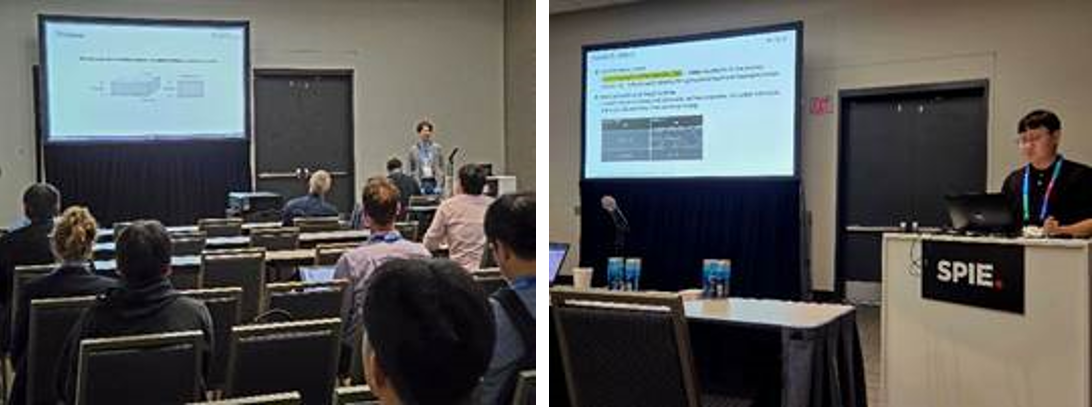
From August 25 to 27, SPIE Optics + Photonics 2026 took place in San Diego, USA. This is one of the biggest conferences in the field of optics. Inside this big event, there was a smaller conference called Optical Manufacturing and Testing 2026. Two people from Meter-Lab went there: Dr. Jonghan Jin (CTO) and Dr. Joonyoung Lee. Dr. Jin was a member of the program committee for Optical Manufacturing and Testing 2026. He also served as chair for two sessions — Session 3 (Optical Manufacturing III) and Session 6 (Optical Testing II). As chair, he helped run the talks smoothly and led the discussions.
On August 26 at 9:20 AM, Dr. Jin gave an invited talk. It was 30 minutes long, and the title was "Line-based thickness measurement using high-resolution spectral interferometry." He talked about a system his team built. It uses a special line-scan spectrometer that can tell apart very small differences in light wavelength. This system checks up to 1,100 points on a line, 200 times per second, and measures both thickness and shape without gaps. He also showed that the system's results are reliable — his team checked it using certified reference materials and repeated tests, and gave exact numbers for how much uncertainty to expect. People in the audience liked this part a lot.
At 9:00 AM, in the same session, Dr. Lee gave an oral talk called "Neural-network-enabled reflectance analysis for thin films on non-ideal substrates." Normally, when a surface is not smooth, light scatters in strange ways. This makes it hard to measure film thickness with the usual method. Dr. Lee's research solved this problem using an AI model (a neural network) that learned how the light scatters. He tested this method on thin films of aluminum oxide sitting on rough aluminum surfaces. The new method could measure thickness at 5 times more points than the old method could.
During the conference, many optics experts talked with the team. They asked how this measurement technology could be used to build and align large optical systems, and how accurate it could be when measuring coating thickness in real time, point by point along a line. These were not simple textbook questions — they were real questions from people thinking about how to use this in their own work.
Through this conference, we could see that our measurement technology is good enough to be discussed with experts at a major international conference. We also confirmed that it matches real problems people face in industry. Going forward, Meter-Lab will keep working closely with experts like these, so we can offer even better research, development, and products to our customers.